
ThermaHive vs. Traditional Varroa Mite Treatments
Why controlled thermotherapy solves what today’s chemical, biopesticide and genetic (RNAi) Varroa treatments cannot. Organized by active ingredient, with the common brand names you will recognize.
Disadvantage source: Honey Bee Health Coalition, “Tools for Varroa Management,” 9th Edition (June 11, 2026)
How much does it actually kill?
Measured efficacy per application, ThermaHive against the published chemical benchmarks
Mite reduction per application
Approximate percentage of mites killed by a single application. ThermaHive’s figure is measured from our own 2026 field season; the chemical benchmarks are Randy Oliver’s published estimates.
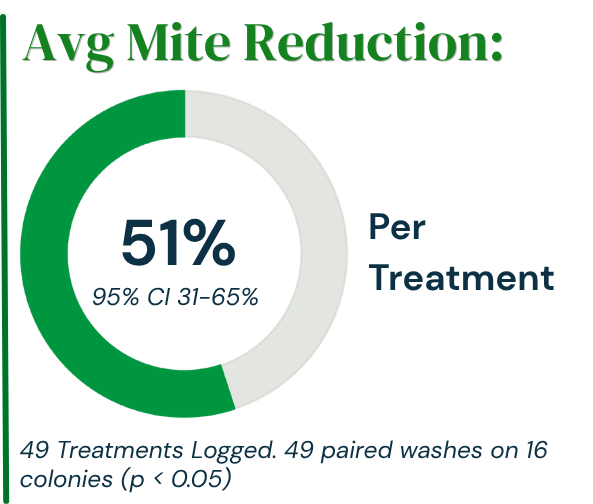

ThermaHive kills about 51% of mites per treatment, measured at a mite wash 14 to 28 days after treatment. That is comparable to one Formic Pro strip, below two strips at 80% and Amitraz at 95%, and well above oxalic acid with brood present at 30%.
Why ThermaHive
A ThermaHive treatment has no temperature ceiling, no honey-super restriction, no waiting period and no resistance pathway, so it can be repeated on schedule rather than squeezed into a weather window.
Six treatments at 51% against the chemical plans
Where a colony’s wash count would sit on November 1 under each plan, on a modelled colony rather than a measured one. Read the coloured lines against the right axis, mites per half-cup of bees.

Our field data runs April 29 to September 2, 2026. Values after September 2 are projected from the model. It also assumes no mite immigration. Our actual hives finished the season between zero and 4 percent.
Key Differentiator Themes
Recurring disadvantage patterns across the chemical, biopesticide, and genetic controls below
Chemical residue in wax, pollen, or honey
7 of 17 chemical controls affectedThermaHive: No chemical is introduced into the hive at any point, so there is nothing to accumulate in comb, pollen, or honey across treatment cycles.
Mite resistance risk
4 of 17 chemical controls affectedThermaHive: Heat kills through a physical mechanism (protein/enzyme denaturation), not a biochemical pathway a mite population can evolve around.
Applicator PPE / health hazard
4 of 17 chemical controls affectedThermaHive: No corrosive acid, fumigant vapor, or organophosphate is ever generated, so no respirator, goggles, or chemical-resistant PPE is required to run a cycle.
Honey-super incompatibility
9 of 17 (10 incl. conditional) affectedThermaHive: Not a chemical treatment, so there is no residue-in-honey risk driving a supering restriction in the first place.
Seasonal / weather-gated application
17 of 17 chemical & biopesticide controls affectedThermaHive: Holds its setpoint from a wireless sensor placed at bee space inside the brood nest, reporting every 2 seconds, so the protocol is not dependent on ambient outdoor weather the way a fumigant or contact chemical is.
Contact-dependent efficacy (no residual/systemic action)
12 of 17 chemical controls affectedThermaHive: Delivers a whole-hive thermal environment rather than depending on physical contact between a product and each individual mite.
Reduced or no effect on capped brood
8 of 17 chemical controls affectedThermaHive: Heat is not blocked by a wax capping the way a contact chemical or vapor can be. The thermal effect reaches the whole brood nest as a system.
Labor-intensive / messy application
6 of 23 controls affectedThermaHive: One controller/heater unit runs a programmed cycle per hive, with no strips to place and no frames to spray or manipulate.
Synthetic Chemicals
3 treatments · grouped by active ingredient, with common brand names included
Synthetic Chemicals
3 treatments · grouped by active ingredient, with common brand names included
Amitraz
Impregnated strip · Common brand: Apivar
No residue, no resistance, fast result
Amitraz
Impregnated strip · Common brand: Apivar
- Contaminates beeswax and pollen in the brood nest, including breakdown byproducts
- Evidence of mite resistance to amitraz
- Long-term treatment protocols (42–56 days) with no immediate mite knockdown
- Some formulations are associated with bees absconding
No chemical is introduced, so there is nothing to accumulate in wax or pollen across seasons. Heat kills through a physical mechanism, so there is no active ingredient for mites to evolve resistance against, and no chemical stressor or off-gassing that could trigger absconding. Treatment cycles run in hours, not 6–8 weeks, and BroodMinder integration gives real-time confirmation of results instead of a multi-week wait.
Tau-fluvalinate
Impregnated strip · Common brand: Apistan
No resistance, no drug interactions
Tau-fluvalinate
Impregnated strip · Common brand: Apistan
- Widespread, well-documented mite resistance
- Elevated fluvalinate residues in wax/comb pollen
- May affect brood development
- Can interact with other pesticides
No documented resistance mechanism to heat exists in the field. Nothing is applied that persists in comb or interacts with other treatments, so it can be freely rotated with any other IPM tool without compounding toxicity.
Coumaphos
Impregnated strip · Common brand: CheckMite+
No reproductive toxicity, no residue
Coumaphos
Impregnated strip · Common brand: CheckMite+
- Mite resistance
- Organophosphate pesticide persists in wax/pollen
- Additive toxicity with other products
- Adversely affects queen/drone reproductive health
No organophosphate or any toxicant is applied, so there is nothing to persist in comb, nothing to compound with other products, and no route for reproductive toxicity. The only treatment variable is temperature/time, actively sensor-monitored and held inside a validated safe window for the whole colony.
Biopesticides
2 treatments · grouped by active ingredient, with common brand names included
Biopesticides
2 treatments · grouped by active ingredient, with common brand names included
Thymol
Gel or vapor-release strip · Common brands: Apiguard (gel), Thymovar (strip)
No queen/brood stress, no honey taint
Thymol
Gel or vapor-release strip · Common brands: Apiguard (gel), Thymovar (strip)
- May reduce queen egg-laying
- Increases adult/larval mortality
- Needs warm temps to work well
- Causes bearding; skin irritant; taints honey
Precision RTD-controlled protocols run a validated temperature/time window that targets mites without the broad physiological stress a thymol vapor places on brood and the laying queen. Nothing enters the honey to taint flavor, and there is no skin-irritant exposure risk for the beekeeper applying it.
Thymol, Eucalyptus Oil & Menthol Blend
Wafer strip · Common brand: ApiLife Var
Controlled thermal range, no honey taint
Thymol, Eucalyptus Oil & Menthol Blend
Wafer strip · Common brand: ApiLife Var
- High temps can drive bees out of the hive or kill brood
- Taints honey if used improperly
- Can melt plastic hive components
Controlled, sensor-verified heating stays inside a defined range rather than being vulnerable to ambient-heat spikes the way a fumigant tablet is. Nothing is released that can taint honey or degrade plastic hive parts.
Organic Acids
7 treatments · grouped by active ingredient, with common brand names included
Organic Acids
7 treatments · grouped by active ingredient, with common brand names included
Formic Acid
Extended-release pad · Common brands: Mite Away Quick Strips (MAQS), Formic Pro
Real-time safety monitoring
Formic Acid
Extended-release pad · Common brands: Mite Away Quick Strips (MAQS), Formic Pro
- Risk of bee brood mortality and queen loss, particularly at higher ambient temperatures
- Colony should not be disturbed during treatment
- Must verify colony is queenright afterward
Because treatment is temperature-based and continuously monitored rather than a caustic vapor released and left unattended for 10–14 days, the operator gets real-time confirmation the colony and queen are tolerating the protocol instead of discovering queen loss after the fact. Safety does not depend on ambient temperature the beekeeper can’t control.
Oxalic Acid Dihydrate
Vaporizer application · Common brand: Api-Bioxal
No applicator PPE required
Oxalic Acid Dihydrate
Vaporizer application · Common brand: Api-Bioxal
- Corrosive
- Vaporizer application is dangerous to applicator health (respirator, goggles, PPE required)
- Must orient upwind; vapors quickly recrystallize
No corrosive acid vapor is generated, so there is no applicator inhalation or eye-contact hazard and no PPE requirement to run a treatment cycle.
Oxalic Acid
Ready-to-use dribble · Common brand: Api-Bioxal
Whole-hive treatment, not manual dosing
Oxalic Acid
Ready-to-use dribble · Common brand: Api-Bioxal
- Every box must be individually exposed and dosed seam by seam between frames
One controller/heater unit treats the whole hive as a system rather than requiring the beekeeper to manually dose every seam between every frame.
Oxalic Acid Dihydrate
Extended-release strip · Common brand: VarroxSan
No frame disruption, no brood damage
Oxalic Acid Dihydrate
Extended-release strip · Common brand: VarroxSan
- Strips are challenging to insert without disrupting bees on the comb
- Difficult to remove from hive
- Expect brood removal behind strips
No strips to insert or remove between frames, and no direct-contact brood damage from a strip sitting against comb. The enclosure delivers heat without physically disturbing the colony’s frames.
Potassium Salt of Hops Beta Acids
Saturated strip · Common brand: HopGuard 3
No contact-kill side effects, no mess
Potassium Salt of Hops Beta Acids
Saturated strip · Common brand: HopGuard 3
- Strips are sticky and messy to handle
- Expect mortality of bees and brood that touch the strip
No sticky residue for the beekeeper to handle, and no direct-contact-kill mechanism that also harms bees or brood that happen to touch the material.
L-Glutamic Acid
Saturated strip · Common brand: Mite Bee Gone (MBG2X5G Strips)
Whole-hive coverage, not placement-dependent
L-Glutamic Acid
Saturated strip · Common brand: Mite Bee Gone (MBG2X5G Strips)
- Effectiveness depends on strip placement and bee traffic/contact patterns
Heat is not dependent on individual bees encountering a specific strip location. The whole-hive thermal environment reaches mites regardless of where they sit in the cluster.
Sucrose Octanoate Esters
Direct spray · Common brand: Sucrocide
No coverage gaps, no direct-strike dependency
Sucrose Octanoate Esters
Direct spray · Common brand: Sucrocide
- Entire frame of bees must be sprayed
- Must directly strike the mite to work
- Limited residual activity
No spray-coverage gaps to worry about. A controlled thermal cycle raises the whole hive environment rather than depending on physically striking every individual mite with a liquid.
Genetic Technologies (RNAi)
1 treatment
Genetic Technologies (RNAi)
1 treatment
Double-Stranded RNA (Vadescana)
Sugar-syrup delivery · Common brand: Norroa (GreenLight Biosciences)
Works regardless of brood stage or forage
Double-Stranded RNA (Vadescana)
Sugar-syrup delivery · Common brand: Norroa (GreenLight Biosciences)
- Only effective when open brood is present, cannot reach mites already capped
- Diluted during heavy nectar flow; consumed by bees during dearth
- Not a fast knockdown treatment
Effectiveness is not tied to brood stage (open vs. capped) or nectar flow/dearth conditions, and treatment cycles are measured in hours rather than requiring weeks for bees to consume and distribute a product.
Methodology Notes
Important distinction vs. the HBHC guide
The HBHC 9th Edition guide currently lists generic “heat/cold treatments” under non-reliable, non-tested, and unregistered methods. That classification applies to informal or unvalidated heat approaches, not to a purpose-built, sensor-controlled thermotherapy system.
ThermaHive holds its setpoint from a wireless sensor placed at bee space inside the brood nest, reporting every 2 seconds, with precise time and temperature control and a full log of every session. The controller reads the colony where the mites are, not the air at the edge of the box. That is a materially different approach than the ad hoc heat methods the guide is referring to. Any external-facing claims should make this distinction explicit rather than imply the guide endorses heat treatment generally.
Brand names are provided for recognizability and reflect commonly sold products for each active ingredient; inclusion is not an endorsement or criticism of any specific manufacturer.