
Heat from below, spread across the footprint
A PTC ceramic element in the Bottom Treatment Frame heats through a diffuser board that spreads output across the full width of the hive rather than concentrating it at one point.
How it works
Varroa mites die at temperatures honey bees survive. ThermaHive holds the brood nest inside that window for the length of a treatment, without opening the hive, pulling frames, or adding a single chemical.
We ran that protocol across a full research apiary in Maryland through 2026, logging every treatment to the second, alongside independent testers in three states. See what the season showed.
ThermaHive setup
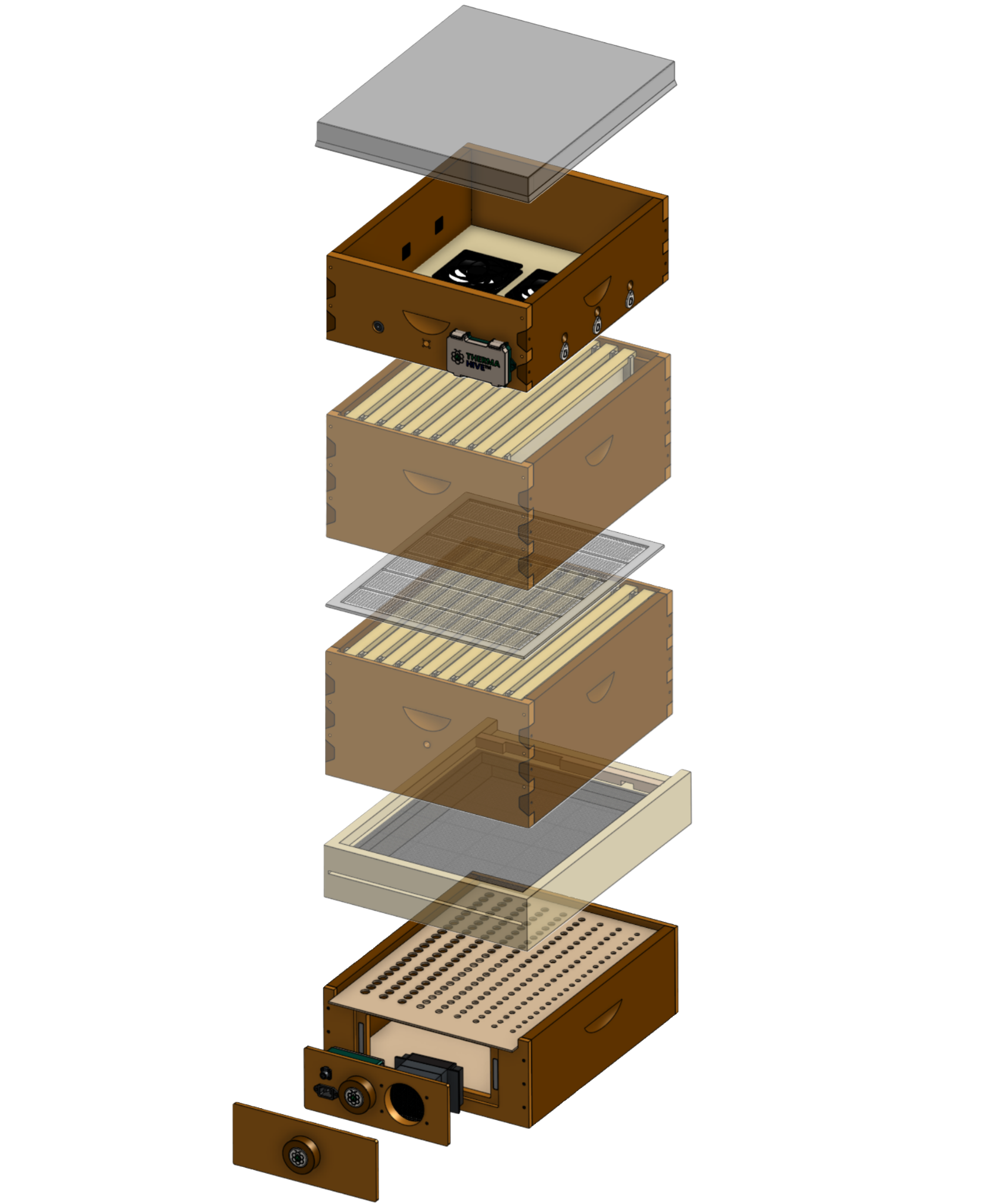
ThermaHive goes above and below the boxes you already own. Your frames, boxes and bees stay exactly where they are. Select any part to see it up close.
ThermaHive parts
Your existing equipment

Tap a number or a part name to see photos.
Held at 108 to 112°F (42 to 44°C), heat kills Varroa while bees and brood come through it fine. A mite cannot evolve its way around that, because you cannot build resistance to physics.
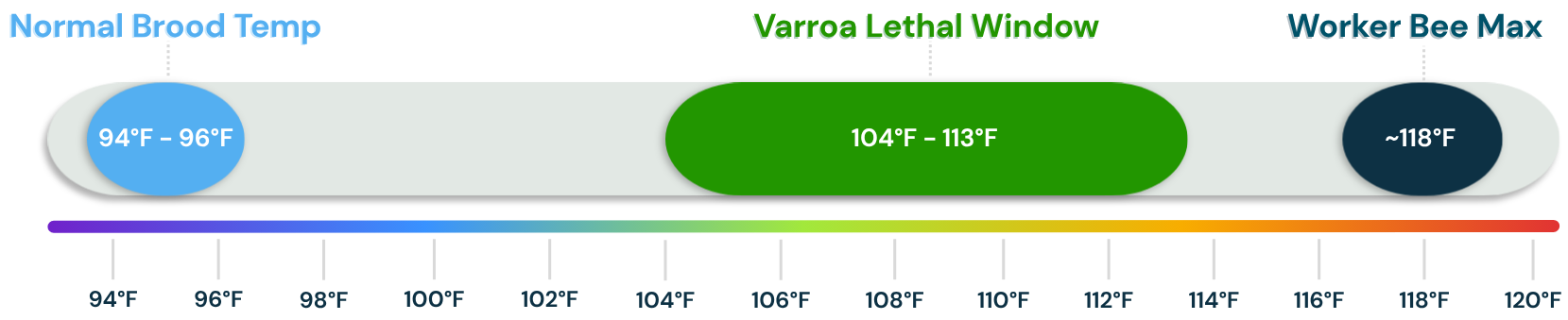
The idea is simple. Holding it is the hard part: the window is narrow, the colony fights the heat by fanning and evaporating moisture, and mites under cappings only die if the heat actually reaches them. That means regulating to the brood nest itself, not the air around it.
A PTC ceramic element in the Bottom Treatment Frame heats through a diffuser board that spreads output across the full width of the hive rather than concentrating it at one point.
Two 120 mm fans, one per half of the hive, move warm air up through the frames. Output scales with the gap to setpoint, so the system pushes through the colony's fanning without overshooting once it arrives.
A wireless sensor sits between frames at bee space and reports every two seconds. Every heating decision is made against what the brood nest is experiencing, not the equipment.


Anyone can make a hive warm. Holding one temperature inside a living, thermoregulating colony for three hours is a control problem, and it is where most of our engineering has gone.
V1 taught us this the expensive way: a sensor in the controller enclosure reads the enclosure, and in our logs it ran several degrees off the colony. Control from that and the heater throttles early, so the treatment never reaches dose.
V2 puts an SHT31-DIS sensor between two frames at bee space instead. No drilling, no cable, nothing to reseat, and it stays put through inspections.
ThermaHive V1 vs V2: what changed (PDF)
Our best recorded hold, July 23, 2026: three hours at a 112°F (44°C) setpoint averaged 112.03°F (44.5°C), standard deviation 0.75°F (0.4°C), with 99.6% of the hold inside ±2°F (±1.1°C).
The fullest, most populous boxes run coolest and take longest to get there, so we log the hold mean and in-band percentage of every treatment.
Fan output steps up as the gap to target widens, with a boost during warm-up to get through the colony's clustering and fanning. Once at target, corrections stay deliberately conservative, because over-correcting after an overshoot just restarts the oscillation.
Every session logs to the SD card, and the in-hive sensors report every two seconds, so you can follow a treatment as it runs in the BroodMinder app. You are not told a treatment happened. You are shown the curve it held.
Watch a treatment from the inside. Air heated at the base spreads through the diffuser board, rises between the frames of both brood boxes, and leaves through the top fans and vent holes. Switch to scenario 02 to see the fans balance a hive with one side chilled by wind.
Loading the simulation…
An illustrative model, not calibrated to our test data, with timing compressed. Toggle °F and °C, change the outside air and target temperature, or switch between the front and side views.

Heat does not spread evenly through a colony: the bottom plate runs hot, the corners run cold, and mites survive in the cold pockets. Fans even that out, but the right speed depends on the hive, so we are building a controller that learns it.
Safety sits outside anything the system learns. If a hive gets too hot the heater shuts off, and no amount of learning can override that.
The thermal model shows why the fans matter. Heat enters at the base, and when one side of the box lags, more airflow on that side brings it level.
During a treatment the controller checks the hive every few seconds and nudges fan speed based on how even the temperature is. That helps immediately, even on a hive it has never seen, but it is reactive.
It also tries a setting for a whole treatment and keeps it only if the result clearly beats its best so far. Weaker results are discarded, so one off day cannot erase a setting that works.
Hard temperature limits, a brood-safety cutoff and a monitor that reverts to the trusted baseline at the first sign of trouble all run underneath, so an experiment in fan tuning can never put a hive at risk.
This system is still in development and is not yet part of a shipping unit. We will share progress as it moves through our own testing.
Two steps happen once. The rest is treatment day, and you are not present for most of it.
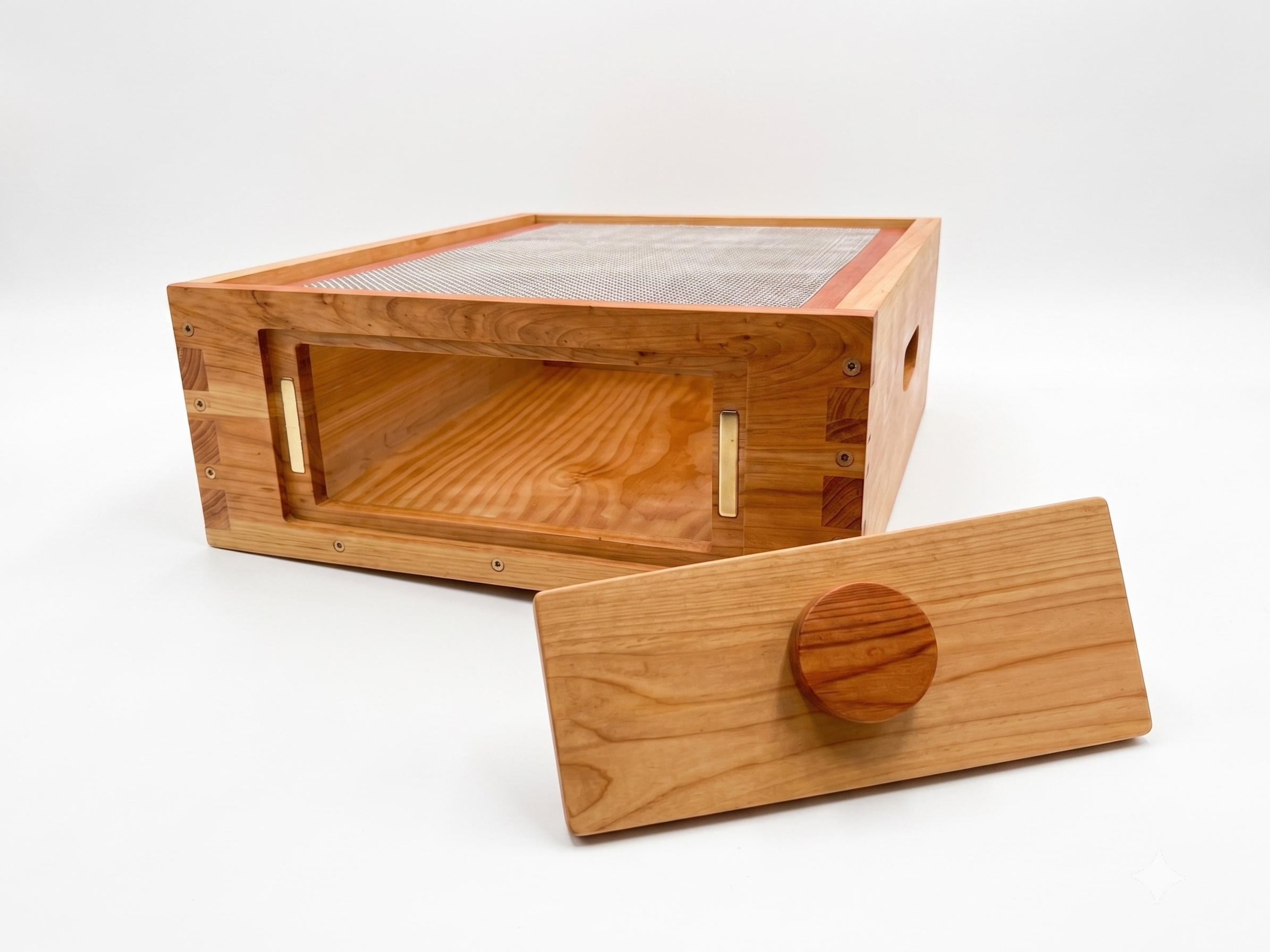
It replaces your screened bottom board, or sits under the one you have. It stays on the hive year round, and with the Blank Insert in place it works as a standard screened bottom board.
Two SHT31-DIS sensors clip into Hex Saddle mounts and drop between brood frames at bee space, no drilling. They stay put through inspections and run on CR2032 coin cells that last around 248 days. See the sensors.
Blank Insert out, Heater Insert in, held by magnets. On treatment day this is the only structural change to the hive.
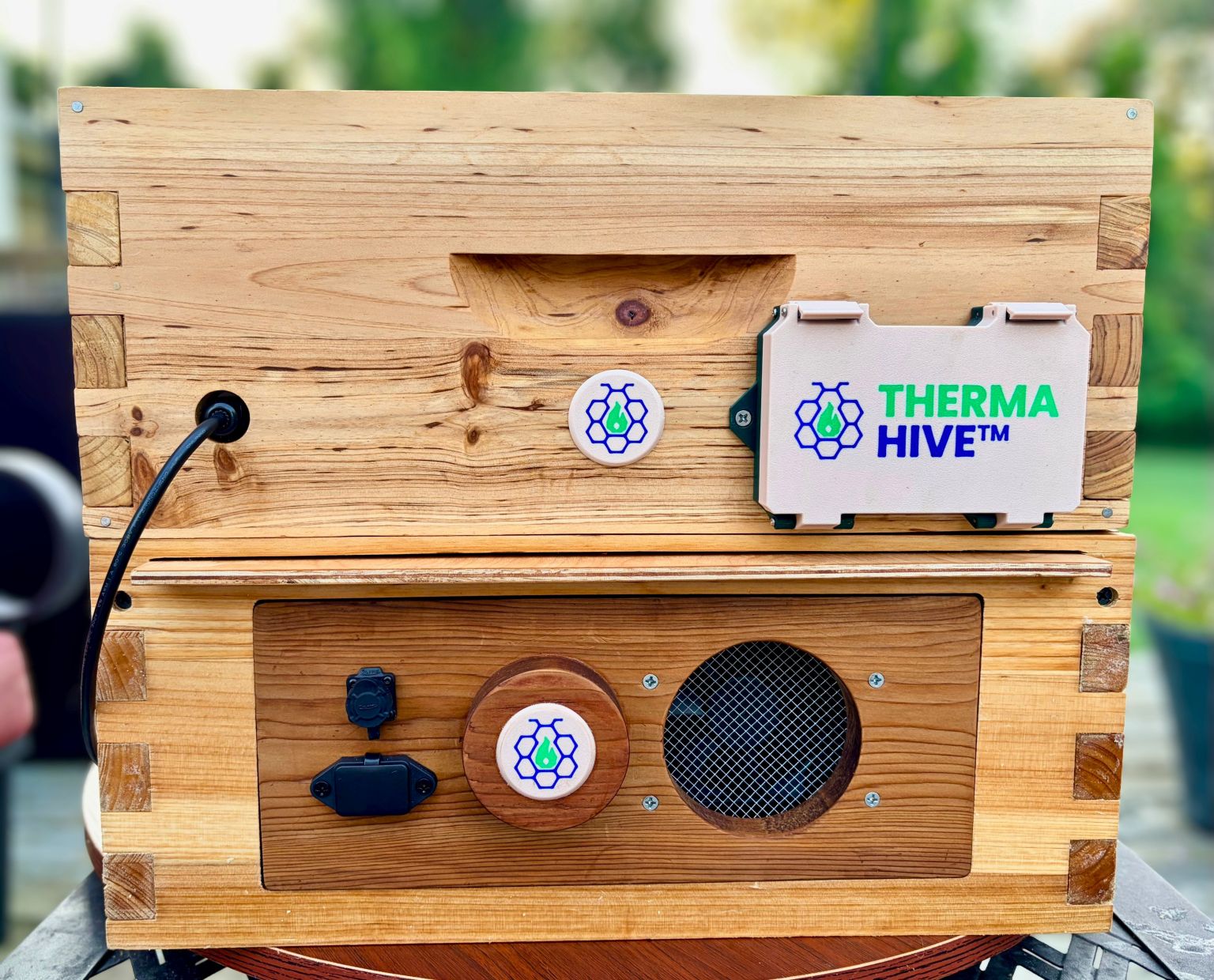
The controller comes pre-mounted. Inner cover off, top box on, telescoping cover back over it, then the cord into the Heater Insert and power from an outlet or a solar battery. Your setup is saved, so later treatments skip the menu.
Set temperature and duration. We recommend 112°F (44°C) for three hours, so that every part of the hive spends at least two hours at 108°F (42°C) or above. Heating starts at once, but the treatment clock only begins when the brood nest reaches setpoint: budget 30 to 60 minutes of preheat, then two to three hours of hold. The hive stays closed, and you do not need to be there for any of it.
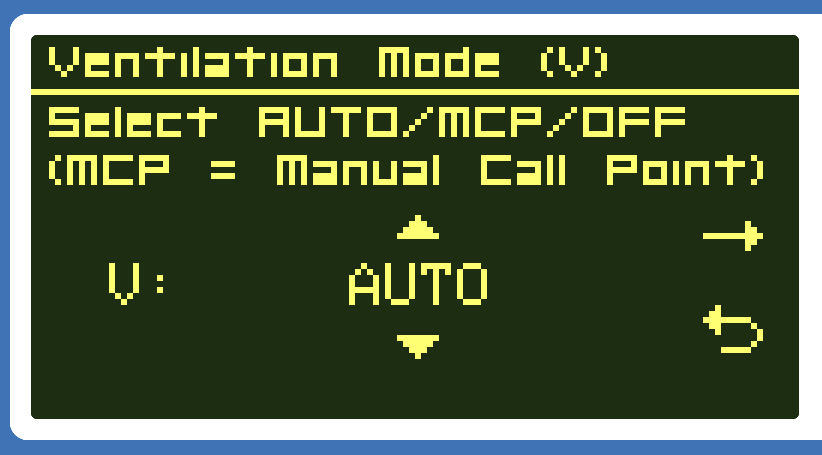
The heater shuts off at the end of the hold, and the fans keep running if Ventilation Mode is on. Every session writes to the SD card: temperature, humidity, phase, settings and safety events, all timestamped, opening in Excel or Google Sheets.
A treatment is not the only thing the controller runs. All four are optional.
Heats when the hive drops below your ideal temperature and stops once it gets there. For winter and early-spring cold snaps.
Runs the fans outside a treatment, to hold normal hive conditions or to cool the hive once a treatment ends.
Fans start when hive temperature rises above your ideal, 95°F (35°C) by default and adjustable either way.
Set an ideal temperature plus temperature and humidity thresholds, and the system works to hold those conditions.


One treatment is a dose, not a cure. Time your rounds to the brood cycle, and read every wash with the brood in mind.
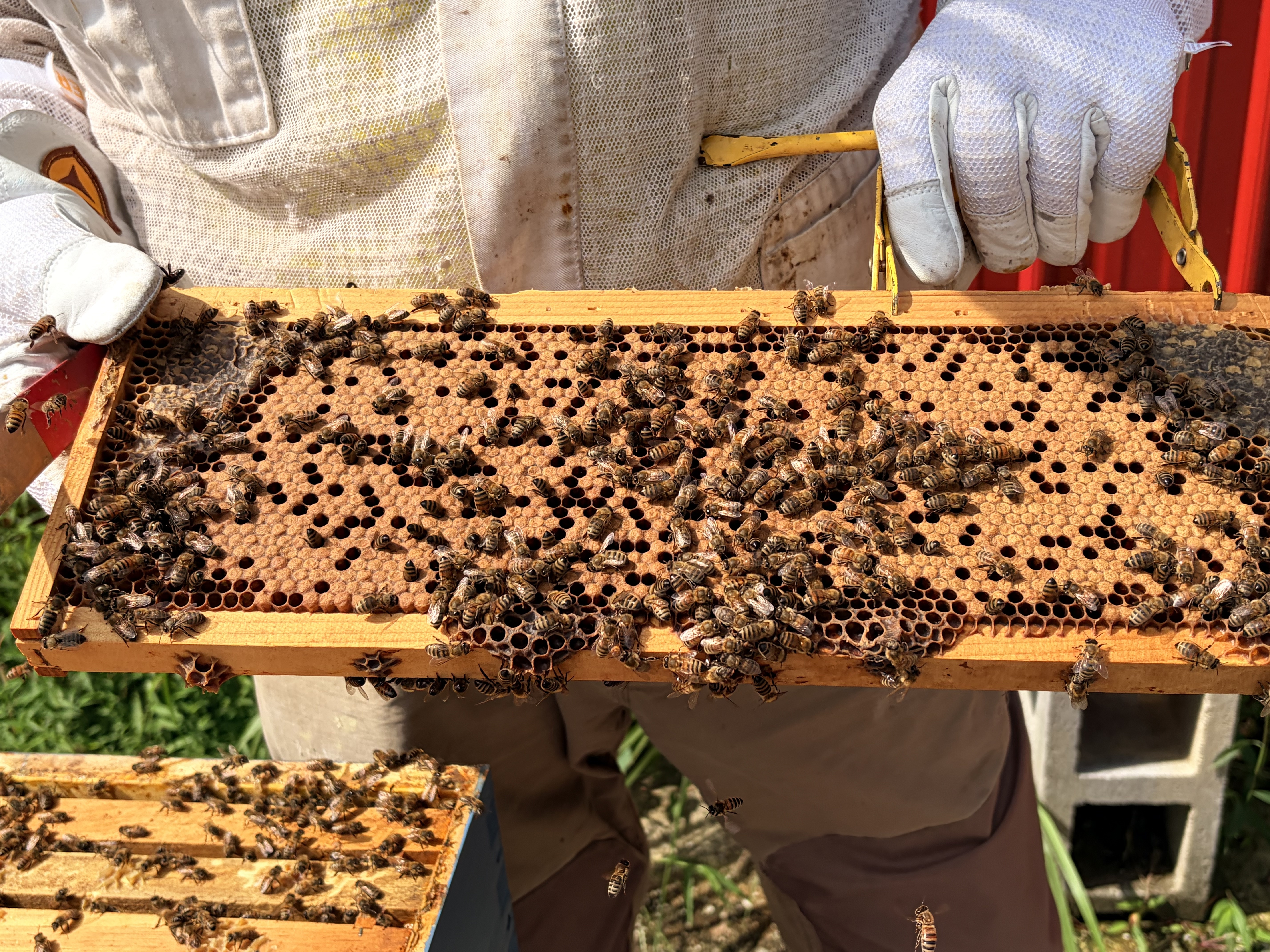
Most of a colony's mites are sealed inside capped brood, where contact treatments cannot reach them. Heat can, and that is the main reason we use it.
But a mite wash only counts the mites riding on adult bees. It cannot show what happened under the cappings until that brood emerges, so a wash is a snapshot of one compartment of the mite population, not a verdict on the treatment before it.
What this means for you:
Heat rises into a super, but a super runs several degrees cooler than the brood nest the controller holds at setpoint, so mites up there get a weaker dose. Keep a queen excluder in place, or treat with the super configured as a brood box.
Four layers protect a running treatment, and they do not depend on each other. Every failure mode ends with the heater off.
Also built in
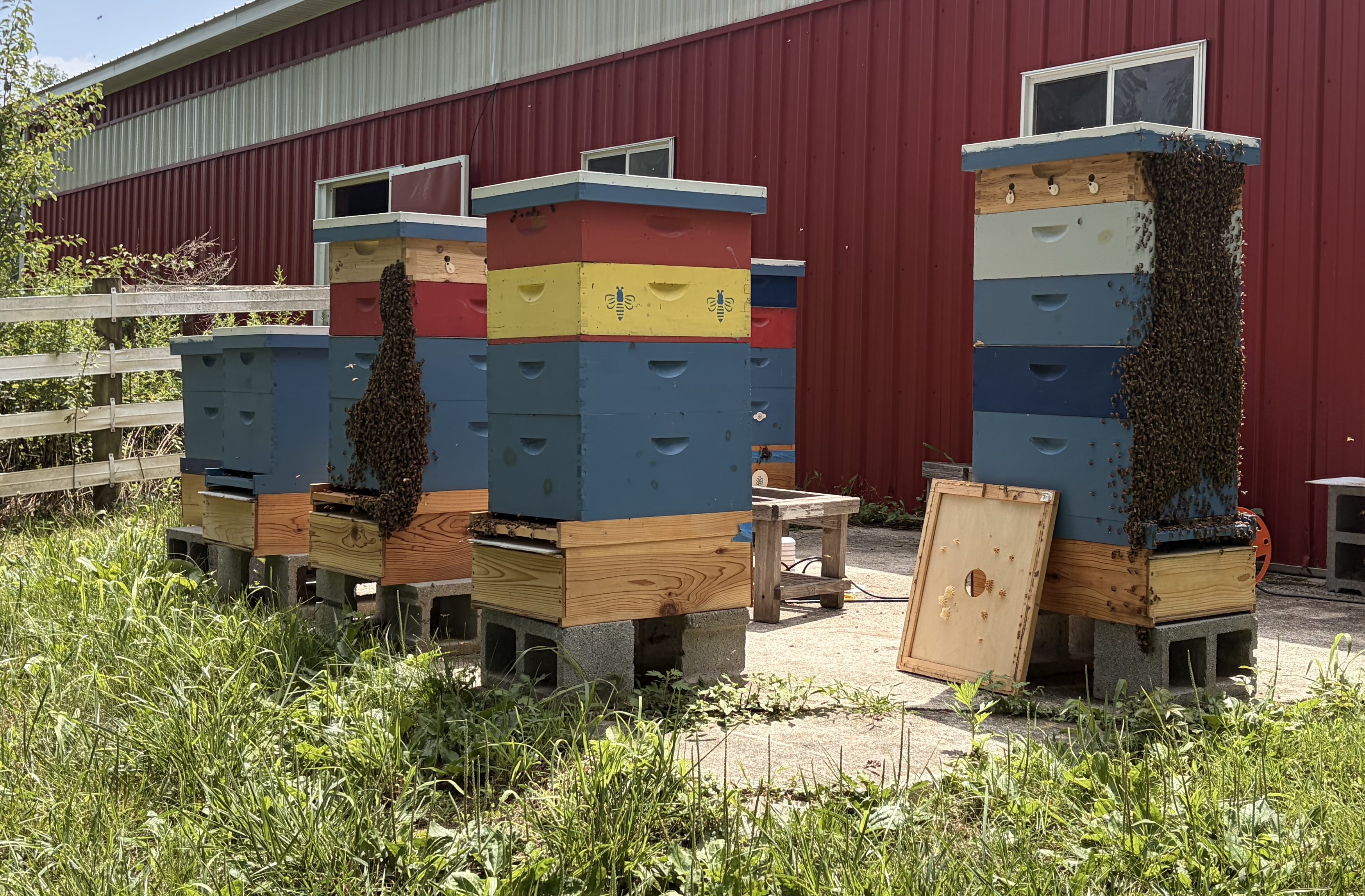
A full research apiary in West River, Maryland, with untreated and chemically treated control groups, under Allan Storm, Master Beekeeper and Maryland State Bee Inspector. Independent testers in three states ran their own units on their own hives.
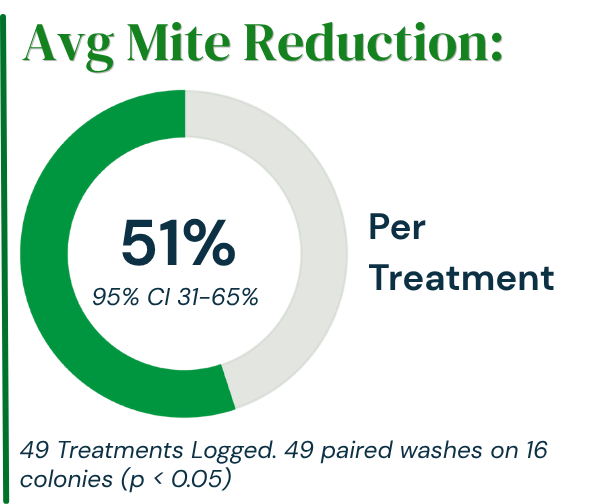


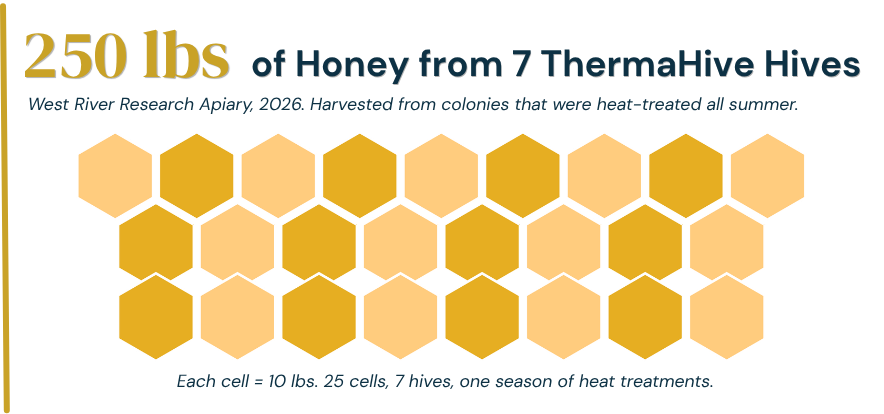
51% average reduction per treatment measured on 49 paired mite washes on 16 colonies (95% CI 31 to 65%). No treated colony was lost, against one of six in the chemical control group. See the full 2026 results.


Colony-by-colony mite trajectories, the independent tester charts, outside verification from the National Honey Bee Survey, and the fourteen washes that came back higher. Read the 2026 field results.
Pre-order the ThermaHive V2 Complete Kit and put this season's field results to work on your own hives, backed by a lifetime warranty.
ThermaHive is not a two-weekends-a-year tool. It stays on the hive.
The expensive part of a thermal system is the controller and the heating element. The part that has to live on every hive is just a bottom board, so we split them.
Every hive gets a Bottom Treatment Frame, a fraction of the cost of a kit, which doubles as a standard screened bottom board the rest of the year. On treatment day you carry the Heater Insert and top box to whichever hive needs them. Your per-hive cost to expand is the frame, not another system, and one controller pairs up to 50 sensors.
Treatment units draw real power. In our apiary three units is the safe maximum on one household circuit; a fourth blew a fuse. Spread them across separate circuits.

Treatment settings, colony safety, what heat does to your honey, and how the system scales across an apiary.
The working range, why there is no single right answer inside it, and how to find yours.
What the EU and Codex thresholds actually require, measured against our own logged exposure data.
The full swap-and-treat cycle, step by step, and what stays on each hive year round.
Download the V2 spec sheet for complete hardware specifications, or pre-order the V2 Complete Kit and treat your first hive chemical-free.